
Expert care for every door.
Pick the job you need — prices, what's included, photos from real work and answers to the usual questions.
Choose a service
Spring Replacement
from $320
Broken torsion or extension spring replaced fast.
A broken spring is the job we prioritise, because the car is usually stuck inside. We replace springs in matched pairs, wind them to the weight of your actual door, re-balance it and test the safety reverse before we leave — normally inside 90 minutes on site, with a one-year warranty on parts and labour and no weekend surcharge.
What’s included
- Matched pair of springs sized to your door's weight and height
- New bearings and centre plate hardware where worn
- Door re-balanced and travel limits re-set
- Safety check on cables, drums and opener force settings
Sounds familiar?
A bang, then nothing
A torsion spring letting go sounds like something heavy dropping in the garage. After it, the opener strains against a door that won't move.
It lifts a foot and stops
Openers have a force limit. With the spring gone it feels the extra weight, gives up a few inches in and reverses — the safety feature doing exactly its job.
A gap in the coil
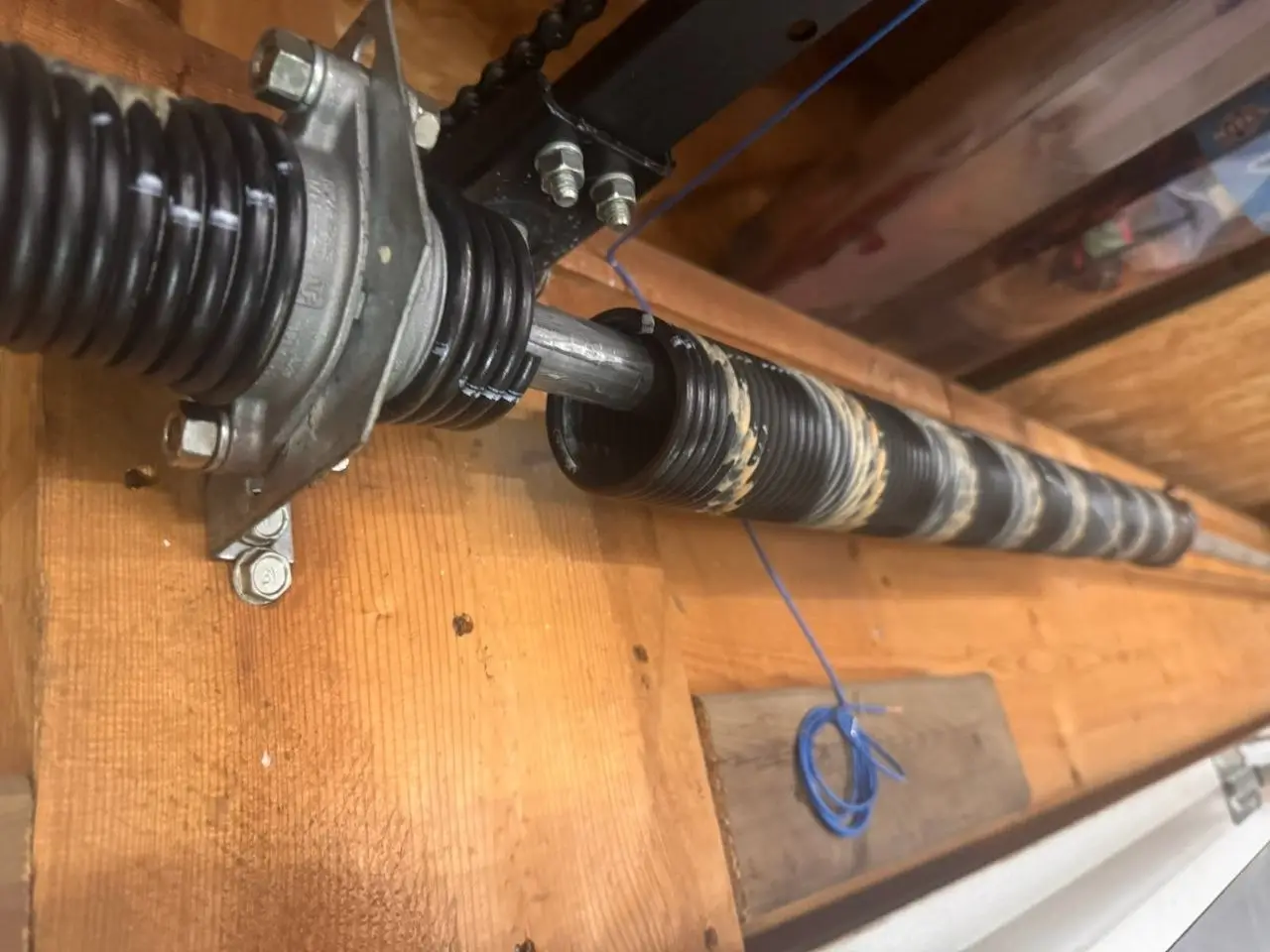
Look at the spring on the shaft above the opening. A two- or three-inch gap in the winding means it has snapped. There is nothing ambiguous about this one.
Impossibly heavy by hand
Pull the release cord and lift. A balanced door feels almost weightless and stays where you leave it. If it fights you, the tension is gone.
One side hangs lower
On a two-spring door, one failed spring leaves the door crooked and drags the cables and rollers out of line — which is how a spring job turns into a cable job.
Torsion or extension — which one is above your door?
Two systems do the same work in different ways. Most Calgary homes built in the last thirty years use torsion; older detached garages often still run extension springs along the tracks.
| Compare | Torsion spring | Extension spring |
|---|---|---|
| Where it sits | On a steel shaft directly above the opening | Along the horizontal tracks, one each side |
| How it works | Stores energy by twisting | Stores energy by stretching |
| Typical life | About 10,000 cycles — five to seven years in a family home | 7,000–10,000 cycles |
| High-cycle option | Yes — 25,000 to 50,000 cycle springs for doors that run all day | Rarely worth doing |
| When it fails | Stays on the shaft | Can whip across the garage unless safety cables are fitted through the coils |
| Balancing | One adjustment point, easier to get exactly right | Both sides have to be matched to each other |
Not sure which you have? Describe what's above the door on the phone, or send a photo — it takes about a minute to identify.
The springs carry the entire weight of your door — most are rated for roughly 7,000 to 10,000 open-and-close cycles before they let go. A break usually announces itself with a loud bang, after which the door won't lift or feels impossibly heavy. Don't keep pressing the remote: an opener isn't built to haul an unbalanced door and will strip its own gears trying. We replace springs in matched pairs so both sides carry equal load and wear at the same rate.
Why springs break
Nothing on a garage door works harder. Every cycle winds and unwinds the spring under full load, and a Calgary winter adds cold-brittle steel to the equation. Manufacturers rate a standard spring at roughly 7,000–10,000 cycles: a household that opens the door four times a day gets there in about five years. Springs almost never fail gradually — they hold full tension right up to the moment they snap.
Why we replace them in pairs
When one spring of a pair goes, the other is the same age and has done the same work. Replacing only the broken one leaves an unbalanced door and a second call-out within months. Matched pairs also keep the load even across the shaft, which is what protects the drums, the cables and the opener gearbox.
High-cycle springs are worth asking about
If your garage is the main way into the house and the door runs six or eight times a day, a standard spring gets through its rated life in two or three years. A high-cycle spring costs more up front and lasts several times longer. We'll tell you when the maths works out in your favour and when it doesn't.
How long it takes
- 5–10 min
Diagnosis
Confirm which spring failed, measure the door's weight and height, and check the drums, cables and bottom brackets while we're at it.
- 10–15 min
Releasing the old spring
Remaining tension comes off with winding bars, then the broken spring comes off the shaft.
- 15–20 min
Fitting the matched pair
New springs onto the shaft, wound to the weight of your actual door, cones set and secured.
- 15–20 min
Balance, lubricate and test
Balance checked by hand, hinges and rollers lubricated, travel and force limits re-set, then several full cycles and a safety-reverse test.
Spring replacement — what it costs
| Work | Price | What’s included |
|---|---|---|
| Single torsion spring | $380 | Spring, install, door balanced, 1-year warranty |
| Matched pair, double door | $480 – $620 | Both springs, balancing, full safety check |
| High-cycle upgrade (25,000+) | from $560 | Heavier-duty springs, same install and warranty |
| Extension spring pair | $320 – $420 | Both springs, safety cables checked |
Before tax, for a standard residential door. No weekend or evening surcharge.
Before & after
After 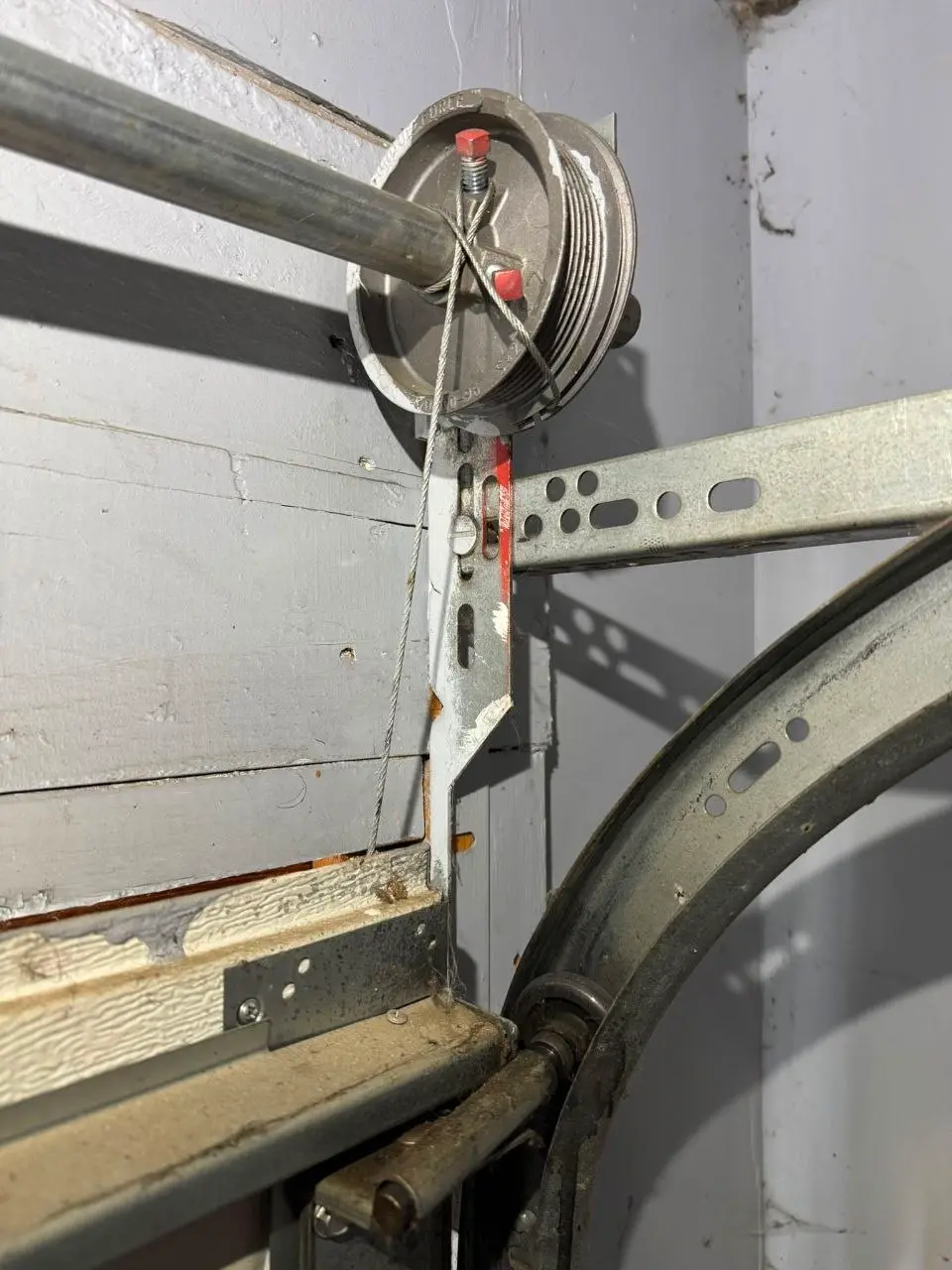 Before
Worn hardware rebuilt
Rusted drum, tired cable and a spring at the end of its cycle life, replaced with a matched pair of springs and a new centre bearing plate.
Photos from this job
Common questions
Can you come the same day?
Usually, yes — springs are the job we prioritise, because the car is normally stuck inside. Calls before mid-afternoon are typically done the same day. If our day is full, we'll say so on the phone rather than leave you waiting.
Can I just replace the spring myself?
A torsion spring holds several hundred pounds of stored energy, and winding bars are unforgiving. This is the one garage door job that regularly sends people to hospital. It also needs the right wire size, length and inside diameter for your door's weight.
How long does the visit take?
A standard double-door spring change runs about an hour on site, including balancing the door and re-setting the opener's travel and force settings.
How long should a new spring last?
A standard spring is rated at roughly 10,000 cycles — one open plus one close. A family using the door four or five times a day gets five to seven years out of that. High-cycle springs rated for 25,000–50,000 cycles are worth it where the garage is the main entrance.
Do I really need both springs replaced?
On a two-spring door, yes. The second spring is the same age and has done the same work, and a mismatched pair leaves the door unbalanced. Doing both in one visit costs less than two call-outs a few months apart.
Opener Repair
from $180
Motor, gears, sensors and remotes — diagnosed and fixed.
Most opener calls are one of four things: a stripped drive gear, a failed logic board, misaligned safety sensors or travel limits that have drifted. We diagnose first and quote the repair against the price of a new unit, so you aren't paying for a motor you don't need. Typical visit is 45 to 90 minutes, warranty included.
What’s included
- Full diagnosis of motor, gears, board and wiring
- Gear kit, capacitor or board replacement as needed
- Safety sensor alignment and reverse test
- Travel and force limits re-set, remotes re-programmed
Sounds familiar?
The motor runs, the door doesn't move
You hear the unit working and the carriage stays put. On a chain or belt drive that is almost always a stripped plastic drive gear — a cheap part, and a repair worth doing on a sound unit.
It starts down, then comes back up
Nine times out of ten this is the two safety sensors near the floor: a bumped bracket, a spider web, or low winter sun straight into the lens. It can also be the close-force setting.
Wall button works, remote doesn't
Usually a remote battery or a pairing lost after a power cut. Worth trying before you book anything — we'll talk you through it on the phone.
Grinding or rattling overhead
A loose chain, a worn sprocket or a rail that has lost its grease. Left alone it wears the gear set and the door's top section.
The light flashes in a pattern
Modern units report faults by blinking a set number of times. That pattern tells us where to look before we even get the ladder out.
It only closes if you hold the button
That's the opener refusing to close unattended because the sensors aren't seeing each other. The fix is the sensors — not holding the button.
Chain drive or belt drive — what to put back up there
If your unit is past repairing, this is the decision that matters. Both lift the same door; the difference you live with is noise.
| Compare | Chain drive | Belt drive |
|---|---|---|
| Noise | Metal chain — you hear it through the floor above | Reinforced rubber belt, noticeably quieter |
| Up-front cost | Cheaper to buy and cheaper to repair | Costs more, but not dramatically |
| Best for | Detached garages, or nobody sleeping above | Attached garages with a bedroom or office over them |
| Upkeep | Occasional tensioning and grease on the rail | Effectively none |
| Lifespan | Ten to fifteen years is normal | Similar — and quieter the whole way |
| Cold weather | Unaffected by Calgary winters | Unaffected by Calgary winters |
Screw drives still exist and still work; parts are simply harder to get. If yours is a screw drive we'll say so before ordering anything.
An opener that hums without moving, reverses for no reason or only works from the wall button is usually telling you something specific. Stripped drive gears, a failed logic board, misaligned safety sensors and worn travel limits all look similar from the driveway and are very different repairs. We diagnose first and quote the repair against the cost of a new unit, so you're not paying for a motor you don't need.
Repair or replace
A gear kit on a sound ten-year-old chain drive is worth doing. A failed board on a unit that predates modern safety sensors usually isn't — you'd spend most of the price of a new opener to keep an old one alive. We'll tell you which side of that line your unit falls on, and why, before anything is ordered.
Sensors are the usual suspect
If the door closes halfway and comes straight back up, look at the two small eyes near the floor. A bumped bracket, a spider web or low winter sun in the lens is enough to trip them. It's the most common call we take that turns out to be a five-minute fix, and we'll happily talk you through checking it on the phone first.
Smart openers, if you want one
Wi-Fi units let you see whether the door is open from your phone and let a delivery or a contractor in while you're out. Worth doing when you're replacing the opener anyway; rarely worth replacing a working unit for on its own.
How long it takes
- 10–15 min
Diagnosis
Test the motor, gears, board, sensors and wiring, and read any fault pattern the unit is flashing.
- 20–40 min
The repair itself
Gear kit, capacitor, board or sprocket swapped out — the part comes out of the van where it's a common one.
- 10 min
Sensors and limits
Sensors aligned and locked down, travel and force limits re-set to the door's actual weight.
- 10 min
Test and hand over
Several full cycles, safety-reverse test, remotes and keypad re-programmed.
Opener repair — what it costs
| Work | Price | What’s included |
|---|---|---|
| Diagnosis and adjustment | $180 | Full diagnosis, sensors aligned, travel and force re-set |
| Drive gear kit | $240 – $320 | Parts, labour, remotes re-programmed |
| Logic board | $320 – $480 | Board, programming, safety-reverse test |
| New opener, supplied and fitted | from $720 | Unit, rail, sensors, remotes, old one taken away |
Before tax. If the repair costs more than half a new unit, we'll say so before ordering anything.
Photos from this job
Common questions
My remote stopped working — is that the opener?
Often it's just the remote battery or a lost pairing after a power cut. Try the wall button first: if the door runs from the wall but not the remote, it's usually a programming or battery issue and a quick fix.
Which openers do you work on?
The common residential chain, belt and screw drives, including LiftMaster and Chamberlain units. If a part is no longer made for your model, we'll tell you straight away rather than chase it.
Can you install a smart opener?
Yes — Wi-Fi enabled units set up with the app, so you can see whether the door is open and let someone in while you're out.
How long does a new opener take to install?
Allow two to three hours for a straight swap, including the rail, the sensors, programming the remotes and a full safety test.
The door reverses only in winter. Why?
Two usual causes: a stiff, cold door needing more force than the limit allows, and low sun angling straight into a safety sensor. Both are adjustments, not new parts.
Cable Replacement
from $220
Frayed or snapped cables replaced and the door re-strung.
A cable that has snapped or jumped its drum leaves the door hanging on one side. We support the door, release the spring tension safely, re-string both cables as a pair, then square and balance the door and test it. Usually under an hour on site, warranty included — and the sooner it's done, the less likely a panel gets bent.
What’s included
- Both lift cables replaced as a pair
- Drums re-set and cables tensioned evenly
- Door re-squared in the tracks and re-balanced
- Rollers, bottom brackets and tracks inspected
Sounds familiar?
The door hangs crooked
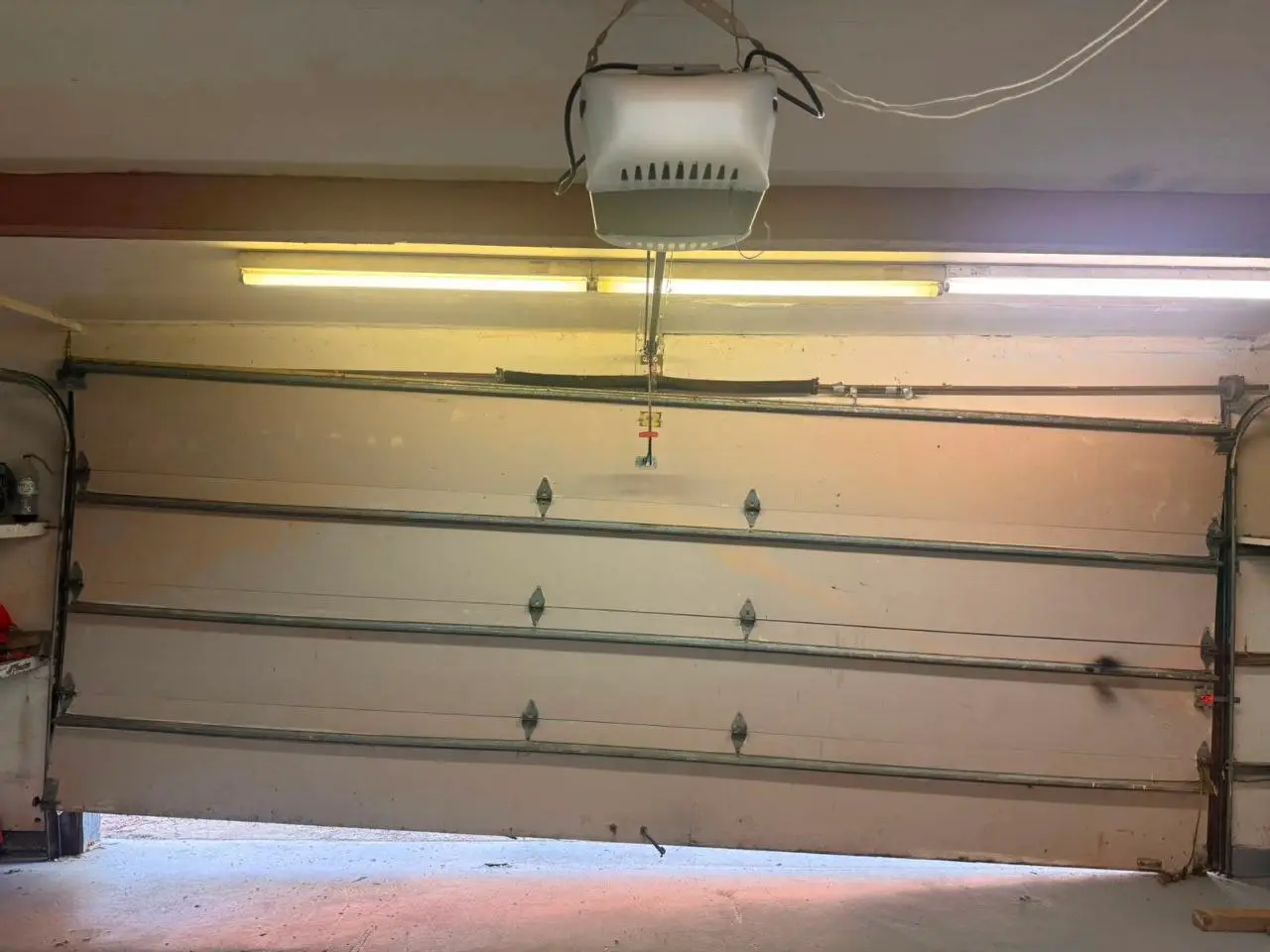
One side sits lower than the other and the gap along the floor is a wedge. That's the weight of the door hanging off a single cable.
A cable is loose or dangling
Slack cable means it has come off the drum or the spring has lost tension. Either way the door isn't being carried the way it should be.
Broken strands or rust near the drum
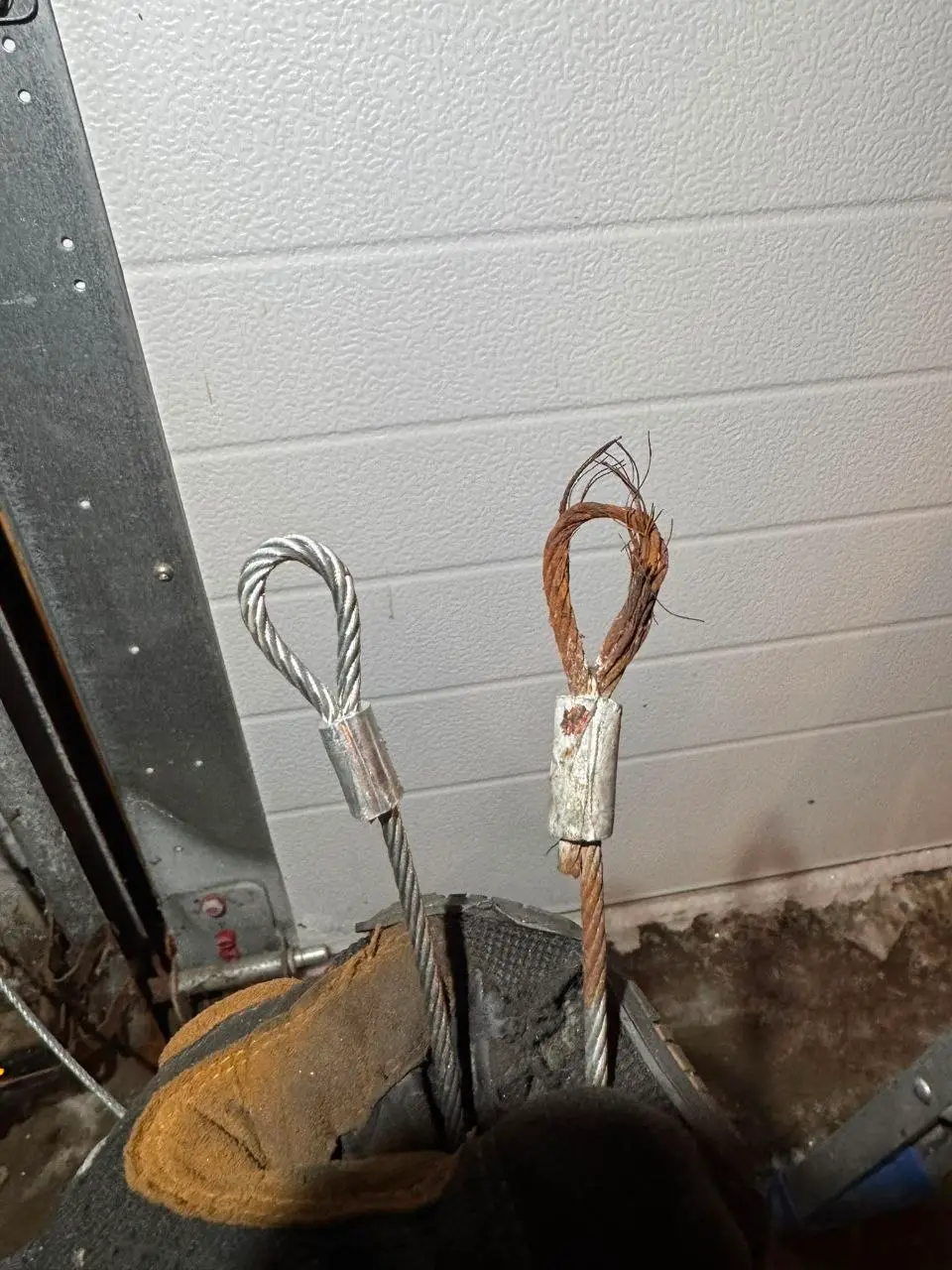
Cables are stranded steel and fail where they bend. Frayed wire at the drum or rust at the bottom bracket is the warning before the break.
The door jams partway
A racked door binds the rollers in the track and stops, usually with a bang and a scrape. Forcing it from there is how panels get bent.
Cable piled up at the bottom
After a spring breaks, the cable has nothing tensioning it and heaps up beside the drum. That's a spring job and a cable job in one visit.
Off the drum, or actually snapped?
Both leave the door crooked, and from the driveway they look identical. They aren't the same repair — here's what tells them apart.
| Compare | Cable off the drum | Cable snapped |
|---|---|---|
| What you see | Cable tangled around the shaft or wound over itself | A loose end hanging, or cable heaped at the bottom bracket |
| Usual cause | Door ran into something, or was forced while off balance | Rust and wear at the drum or the bottom of the track |
| If you keep using it | The drum can come off the shaft and the door drops | The second cable takes the whole weight and follows |
| Typical fix | Tension released, cable re-seated and re-wound, door re-squared | Both cables replaced as a pair, door re-squared and balanced |
| Time on site | Around 30–45 minutes | Around 45–60 minutes |
If a panel is bent or the door has come off its tracks, that's quoted separately — and you'll get the number before anything starts.
Lift cables carry the door's weight between the spring and the bottom bracket. They fray strand by strand where they wrap the drum, and once one lets go the door drops on that side, jams in the track and often kinks a panel. A cable that has jumped off its drum needs the door supported and the spring tension released before anything else happens — that's why a snapped cable is a call, not a DIY afternoon.
What actually wears out
The cable itself is stranded steel, and it fails where it bends: at the drum and at the bottom bracket. Water off the car, road salt and a concrete floor that stays damp all winter corrode the bottom few inches first. That's why we replace cables in pairs — the second one has lived the same life as the first.
Why the door goes crooked
With one cable gone, the whole weight of the door hangs off the other side. The door racks in the tracks, the rollers bind, and the panel above the bottom bracket takes the twist. Left running, a cable problem becomes a panel problem — which costs considerably more than the cable did.
The bottom bracket deserves a look
The bracket the cable hooks into sits under full spring tension whenever the door is down. On older doors the bolt holes elongate and the steel thins with rust. If yours is at that stage we'll show you before replacing it, because a bracket letting go is what turns a cheap repair into a bent door.
How long it takes
- 10–15 min
Secure the door
Door supported and clamped, spring tension released with winding bars so nothing is under load.
- 10 min
Old cables off
Cables unhooked at the bottom brackets and unwound from the drums; drums and bearings checked while they're exposed.
- 15–20 min
New pair fitted
New cables seated in the drums, wound evenly and tensioned so both sides carry the same weight.
- 15 min
Square, balance and test
Door re-squared in the tracks, spring tension re-set, balance checked by hand, then full cycles and a safety-reverse test.
Cable work — what it costs
| Work | Price | What’s included |
|---|---|---|
| Cable re-seated on the drum | $220 – $280 | Tension released, cable re-wound, door squared |
| Pair of lift cables | $320 | Both cables, even tension, balance and safety check |
| Cables and drums | $420 – $520 | Cables, both drums, bearings checked |
| Door off its tracks | from $380 | Door re-railed, squared and balanced |
Before tax. A bent panel is quoted separately — you get that number before we start.
Before & after
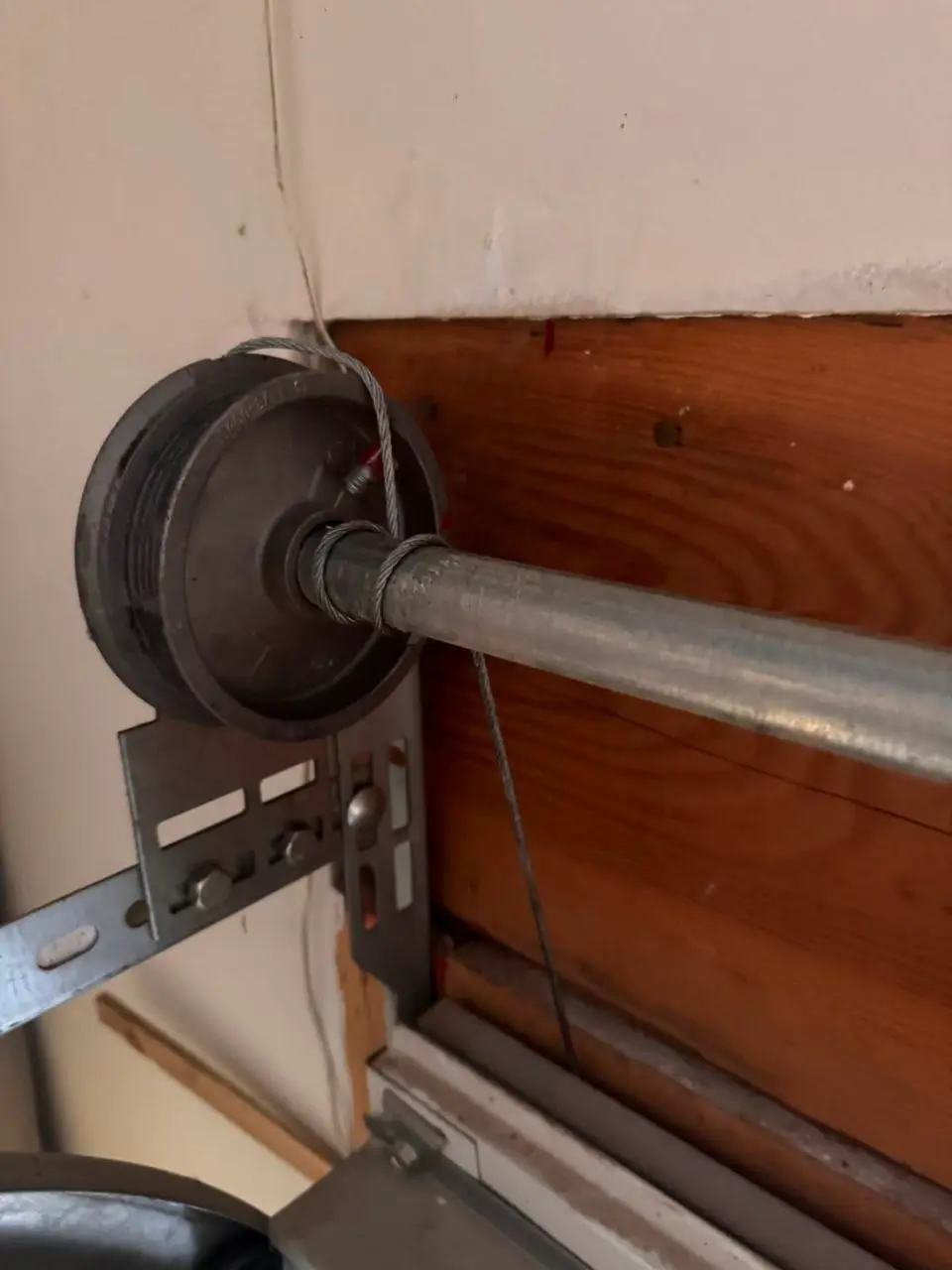 After
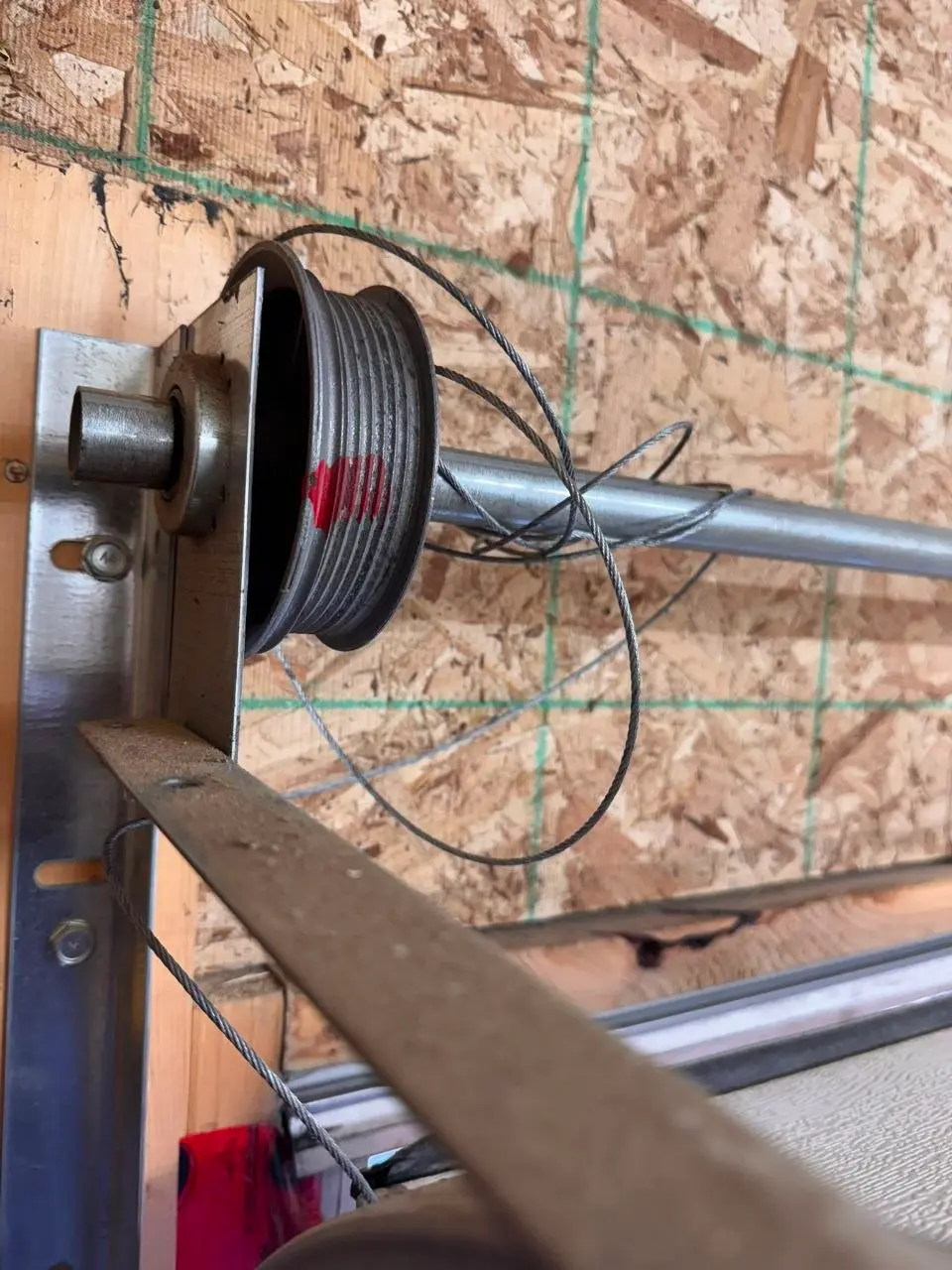 Before
Lift cable back on the drum
The cable had wound off its drum and tangled on the shaft, leaving the door hanging crooked. Tension released, cable re-strung and seated, door re-squared and balanced.
Photos from this job
Common questions
The cable came off the drum — is that the same repair?
Usually a bit less. If the cable itself is sound, we release the tension, re-seat and re-wind it, then re-square and balance the door. If it's frayed where it sat on the drum, it gets replaced.
Will you need to replace the spring too?
Not necessarily. Cables and springs fail independently, though on a door old enough to lose a cable it's worth knowing the spring's remaining life. We'll show you what we see and let you decide.
How long will it take?
A straightforward pair of cables on a double door is usually under an hour. If the door has come off the tracks or a panel is bent, we'll quote that separately before starting.
Can I get my car out first?
Ask us on the phone before you try. On some doors it's safe with two people and the release pulled; on others the door is holding itself up on one cable and lifting it is exactly what brings it down.
How long should new cables last?
Ten years or more on a door that stays balanced and dry. What shortens them is a door that's out of balance, a drum that isn't tracking straight, or standing water on the garage floor all winter.
Door Maintenance
from $120
A full tune-up: balance, hardware, rollers, sensors and seals.
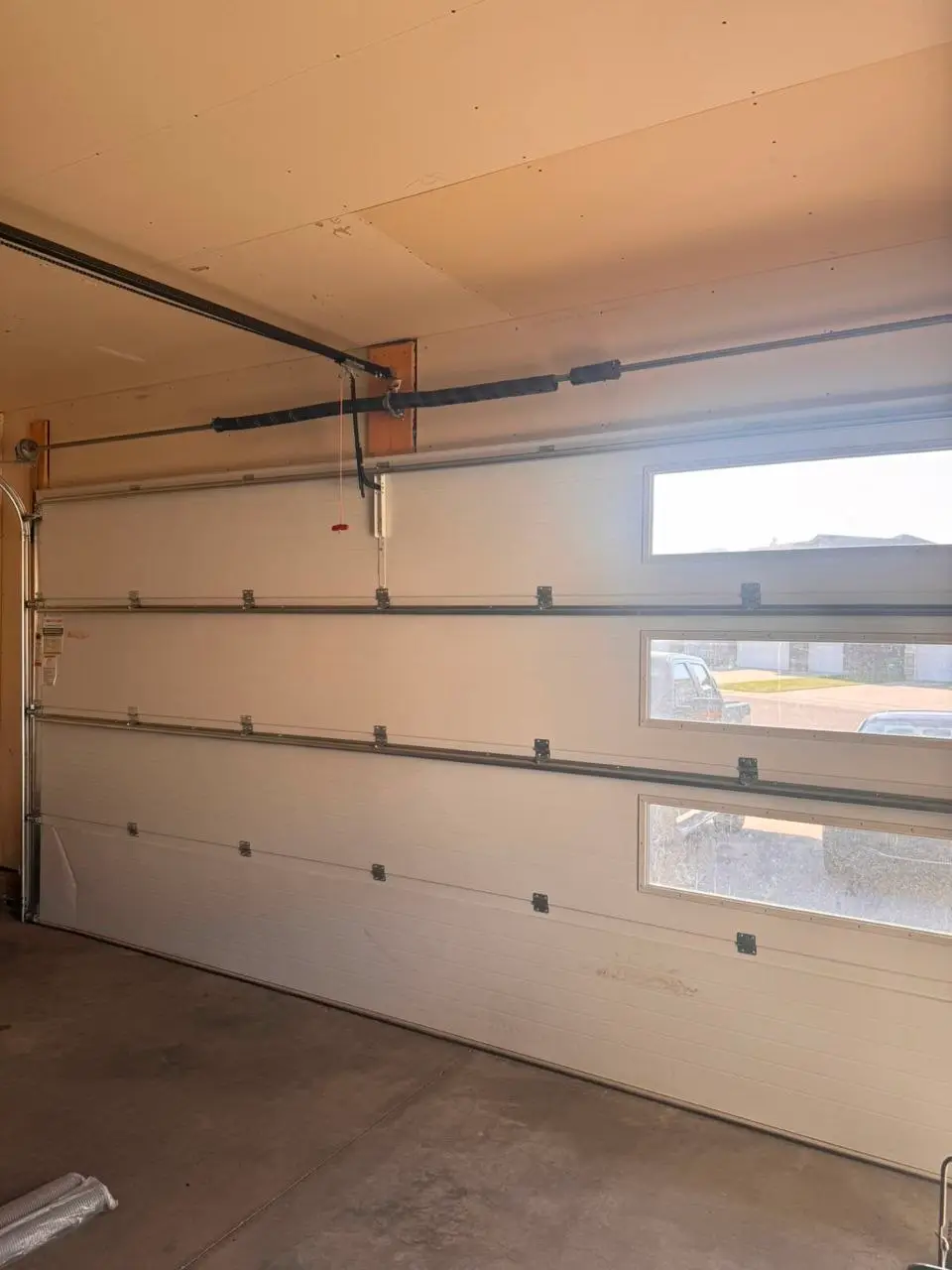
A tune-up is an hour that checks the balance by hand, tightens what a few thousand cycles have shaken loose, lubricates the moving steel and tests the safety reverse. Do it in the fall, before the cold arrives — that's what turns a January emergency into a September appointment.
What’s included
- Balance test and spring tension adjustment
- All hinges, brackets and track bolts tightened
- Rollers, bearings and hinges lubricated
- Safety sensors aligned and auto-reverse tested
- Weather seal and bottom rubber checked
Sounds familiar?
It's got noisy
Grinding, squealing or a bang at the top of travel. Noise is a door telling you something is dry, loose or out of line — all cheap now, none of them cheap later.
It shudders on the way up
A door that jerks rather than glides is usually running on worn rollers or dry bearings, or is slightly out of balance.
The last foot slams
If the door drops the final stretch instead of settling, the spring tension is off. That impact is what cracks the bottom section over time.
Cold air and snow get under it
The bottom rubber goes hard and splits in a Calgary winter. A new seal is a small part that makes the garage noticeably warmer.
It's never been serviced
If the door is a few years old and nobody has touched it since install, the balance has drifted and the hardware has loosened. That's the normal state of things — not neglect.
A tune-up, or waiting for it to break
The comparison people actually care about. Neither column is a scare tactic — both are the ordinary way this goes.
| Compare | Serviced once a year | Serviced when it fails |
|---|---|---|
| When it happens | On a day you picked, in the fall | The morning you're late, usually in January |
| What it costs | One visit, an hour, no parts in most cases | An emergency visit plus whatever broke |
| Car access | Unaffected | Usually stuck inside until we arrive |
| What wears next | Rollers and hinges, gradually | The spring, the opener gearbox, or a panel |
| Effect on the door's life | Balanced door, spring used within its rating | Every cycle loads parts that weren't designed for it |
Maintenance can't stop a spring reaching the end of its cycle life. What it does is keep everything else from wearing out early because of it.
Most of the emergency calls we take were avoidable. A door that's out of balance makes the spring and the opener do work they weren't designed for, and the parts that give out first are the cheap ones — rollers, hinges, bearings. A tune-up checks the balance by hand, tightens what has shaken loose over a few thousand cycles, lubricates the moving steel and tests the safety reverse.
Do it before winter, not during
Cold thickens old grease, stiffens the weather seal and finishes off springs that were already near the end. Twenty minutes of attention in September is what stops a −25°C call in January. If you only service the door once, do it in the fall.
Balance is the whole game
Disconnect the opener, lift the door halfway by hand and let go. A balanced door stays put. If it drops or flies up, the spring tension is wrong and every cycle is loading the opener, the cables and the drums. That single check tells us more than anything else on the door.
What lubrication is and isn't
Hinges, rollers, bearings and the spring want a light garage-door lubricant. The track does not — oil in the track collects grit and turns into a grinding paste. We'll leave the door quiet and show you the three places worth a spray twice a year.
How long it takes
- 10 min
Inspect and balance
Door run by hand off the opener, balance checked, spring tension adjusted where it has drifted.
- 10–15 min
Hardware
Hinges, brackets, track bolts and the bottom brackets checked and tightened; worn rollers flagged.
- 5–10 min
Lubrication
Hinges, rollers, bearings and spring treated with proper garage-door lubricant — and nothing in the track.
- 10 min
Sensors, limits and seals
Safety sensors aligned, auto-reverse tested, travel and force re-set, weather seal and bottom rubber checked.
- 5 min
What we found
A plain summary of anything worn, with a price — nothing is replaced without you agreeing to it first.
Tune-up — what it costs
| Work | Price | What’s included |
|---|---|---|
| Single door tune-up | $120 | Balance, hardware, lubrication, sensors, seal check |
| Double door tune-up | $150 | The same list on a double door |
| Each extra door, same visit | $90 | Same checks while we're on site |
| Roller set replaced (10) | from $180 | Nylon rollers fitted and lubricated |
Before tax. Parts found worn are quoted before anything is changed.
Photos from this job
Common questions
How often should a door be serviced?
Once a year for a typical household. If your garage is the main entrance to the house and the door runs six or eight times a day, it earns a look more often.
Will you find things that need replacing?
Sometimes — worn rollers, a dry bearing, a bottom seal that's gone hard. You'll get the price before anything is changed, and nothing gets replaced because it's old if it's still doing its job.
Does maintenance really prevent a broken spring?
It can't stop a spring reaching the end of its cycle life. What it does is keep the door balanced so the spring isn't asked for more than it was rated for, and it gives us a chance to warn you when a spring is visibly near the end.
What lubricant should I use between visits?
A garage-door specific lubricant on hinges, rollers, bearings and the spring. Not on the track, and not WD-40 — it's a solvent that strips the grease you want to keep.
Can you service more than one door in a visit?
Yes, and it's cheaper per door that way. Tell us how many when you call so we book enough time.
New Door Installation
from $2,195
A new insulated door, measured, fitted and finished.
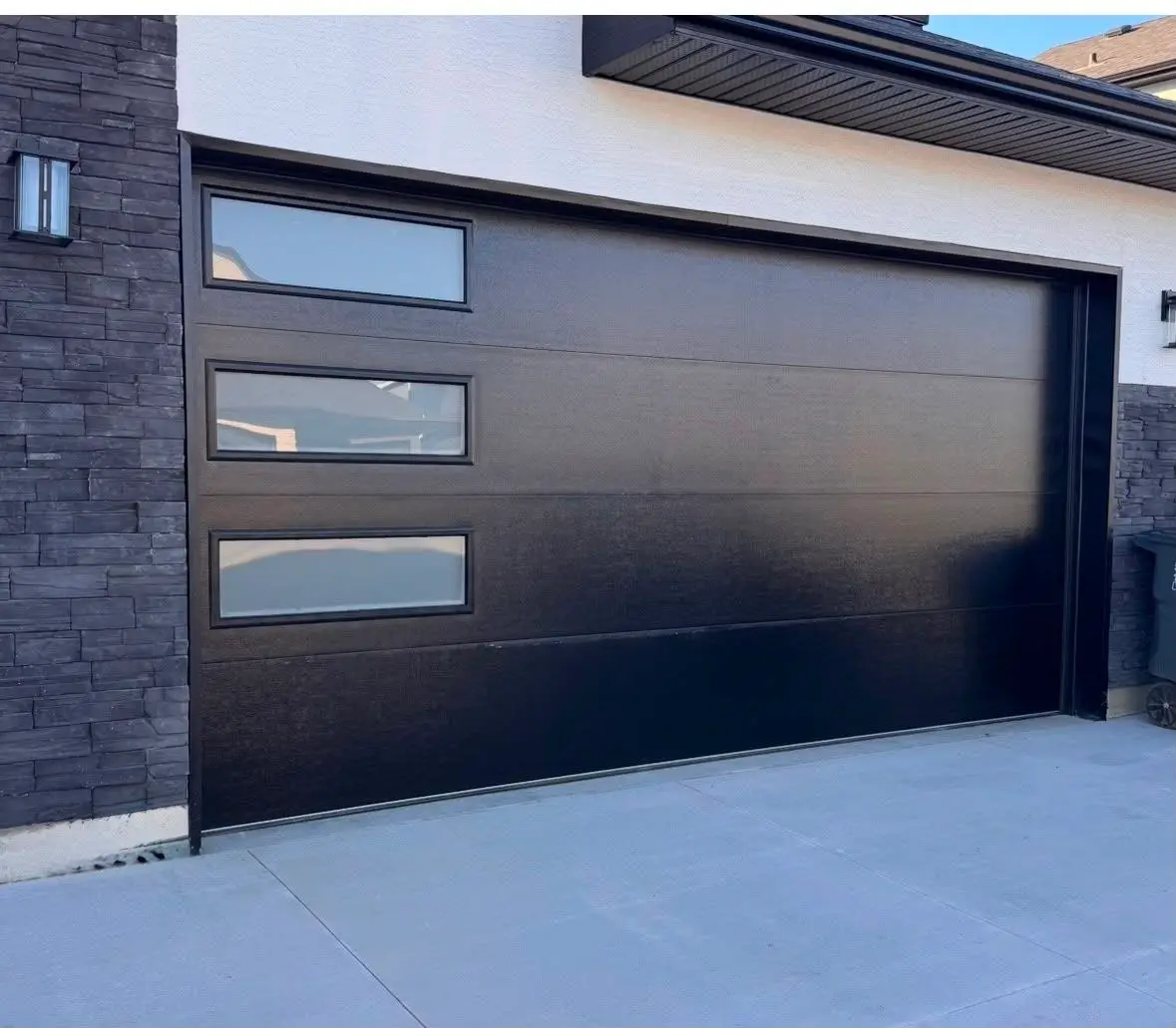
One visit to measure and quote, then one price covering the door, the springs and hardware sized to it, the install, and taking the old door away. Most single doors go in inside a morning; a double with an opener re-fit takes most of a day. In Calgary the insulation level matters as much as the colour — we'll walk you through both.
What’s included
- On-site measure and a written quote
- Insulated sectional door in your choice of style and colour
- New tracks, springs, rollers and weather seals
- Old door removed and disposed of
- Opener re-fitted, balanced and safety-tested
Sounds familiar?
The bottom section is rusted or split
The bottom of the door lives in snow melt and road salt all winter. Once that section is gone, a single replacement panel often costs enough that a new door makes more sense.
Repairs are getting frequent
A spring one year, cables the next, hinges after that. On a door past fifteen the parts are all the same age, and you're paying in instalments for a door you don't have yet.
The garage is freezing
A single-skin steel door is a large cold wall. If the garage is attached — and especially if there's a room above it — insulation is the upgrade people notice most.
Somebody backed into it
A dented or bowed section binds in the tracks and puts the door out of square. Sometimes it's one panel; sometimes the door was already at the end of its life.
It lets the house down
The garage door is usually the largest single surface on the front of a Calgary home. A new one changes the look of the house more than anything else at that price.
Insulated or single-skin — the decision that matters here
Style is personal; insulation is physics. This is the one choice where Calgary changes the answer compared with a milder city.
| Compare | Insulated sectional | Single-skin steel |
|---|---|---|
| Garage temperature | Noticeably warmer — worth it on an attached garage | Tracks the outdoor temperature closely |
| Room above the garage | Warmer floor, less draught | The usual reason that room is cold |
| Noise | Stiffer panels, quieter travel | Thinner steel drums and rattles |
| Dents | Backed with foam — stands up to a stray hockey puck | Dents from the same knock |
| Up-front cost | Higher | Lowest option |
| Best for | Attached garages, workshops, anything heated | A detached garage used for storage |
Between those two sits a double-skin door with polystyrene board — cheaper than polyurethane, better than nothing. We'll bring the numbers for the sizes that fit your opening.
A new door is the biggest single change you can make to the front of a house, and in Calgary it's also an insulation decision. We measure the opening, walk you through panel styles, glass, colour and R-value, and give you one price that covers the door, the hardware, the install and taking the old one away.
Insulation actually matters here
A single-skin steel door in a Calgary winter is a large, cold wall. An insulated sectional keeps the garage usable, keeps the room above it warmer, and runs noticeably quieter because the panels are stiffer. If the garage is attached and you park a car with any snow on it, it's the upgrade people notice most.
Styles we fit
Flush and modern long-panel for newer builds, raised panel for the classic look, and carriage style where the house calls for it — with or without a row of glass. Colour is matched to the trim rather than the siding in most cases; we'll bring samples to the measure.
What happens on install day
The old door and tracks come out, the opening is checked for square, the new sections go in from the bottom up, then springs are wound to the weight of the actual door and the opener is re-fitted and re-balanced. Most single-door installs are a morning; doubles and awkward openings can run longer.
How long it takes
- 30–45 min
Measure and quote
Opening measured, headroom and side room checked, styles and colours gone through. You get the price in writing with the lead time.
- varies
Order and lead time
Common sizes and colours are quick; custom sizes, colours and glass are ordered in. The wait is on the quote, not a surprise later.
- 45–60 min
Old door out
Door, tracks and old hardware removed and taken away, and the opening checked for square and rot.
- 60–90 min
New door in
Sections set from the bottom up, tracks aligned, rollers and hinges fitted, weather seals set.
- 45–60 min
Springs, opener and test
Springs wound to the new door's weight, opener re-fitted, travel and force set, safety reverse tested and the site cleaned up.
New doors — what it costs
| Work | Price | What’s included |
|---|---|---|
| Single insulated door, installed | from $2,195 | Door, tracks, springs, install, old door removed |
| Double insulated door, installed | from $2,850 | The same on a double opening |
| Glass inserts | from $180 / section | Lites fitted at build |
| Opener fitted with the door | from $720 | Unit, rail, sensors, remotes |
Before tax. Custom sizes, colours and glass are quoted at the measure.
Before & after
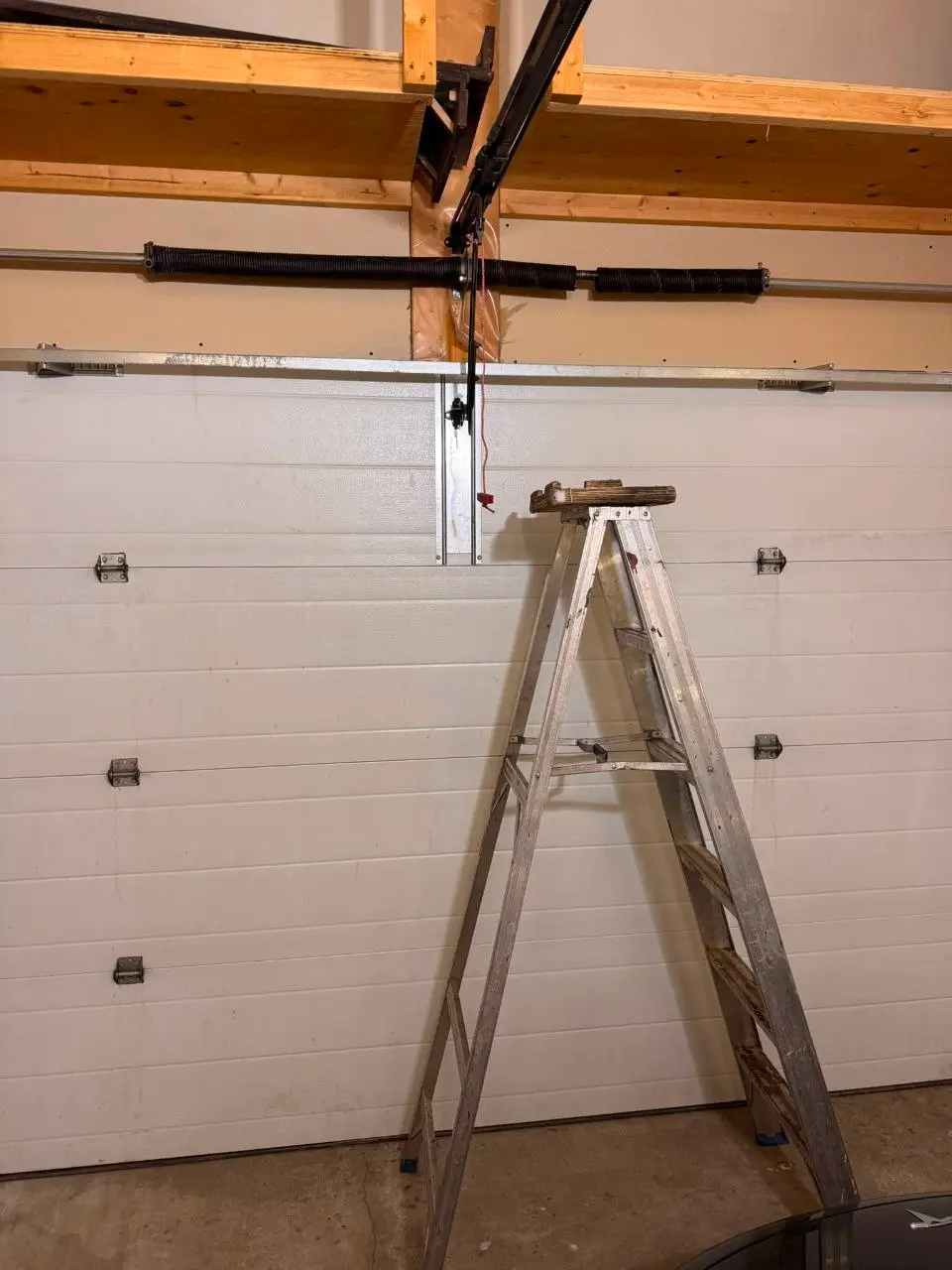 After
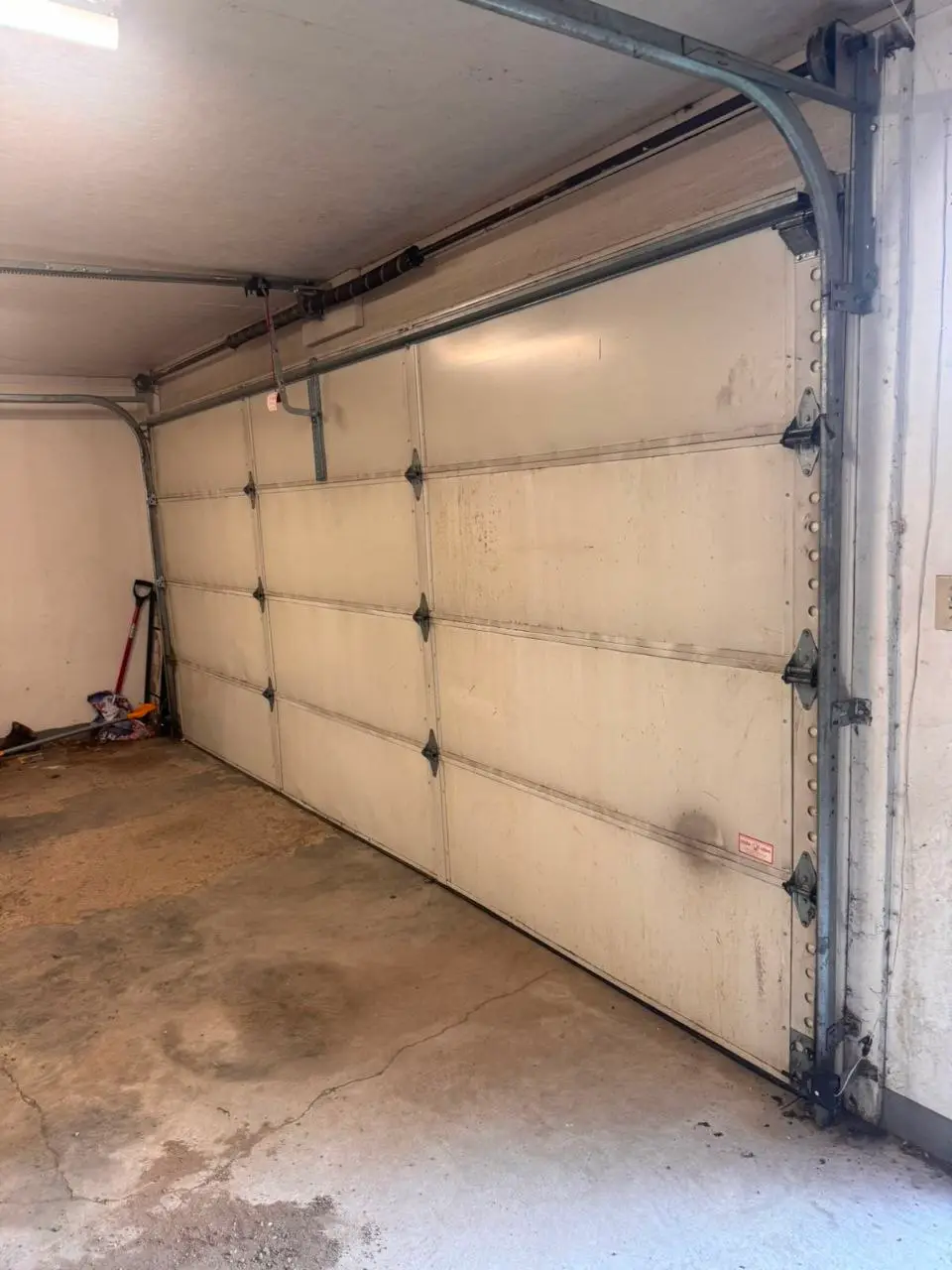 Before
Tired door replaced
A stained, dented single-skin door taken out and a new insulated sectional hung in its place — new tracks, rollers and springs sized to the new door's weight.
Photos from this job
Common questions
How long from order to install?
It depends on the door. Common sizes and colours are quick; a special size, a custom colour or a glass configuration is ordered in. You'll be given the lead time in writing with the quote.
Can you keep my existing opener?
Usually yes, if it's sound and matches the new door's weight. We'll say plainly if an older unit isn't worth re-fitting rather than hanging a new door off a tired motor.
Do you take the old door away?
Yes — removal and disposal are in the price, including the old tracks and hardware.
What R-value should I be looking at?
For an attached Calgary garage, the insulated doors worth having start around R-12 and go up from there. A detached garage used for storage doesn't need it. We'll give you the actual numbers for the doors that fit your opening.
Can I get a door to match the house?
Usually. Stock colours cover most homes; beyond that there are custom finishes and woodgrain looks. We bring samples to the measure so you're choosing in daylight against your own siding.
Commercial Service
Free quote
Shop, warehouse and multi-bay doors kept running.
A door that's down is a bay that isn't earning. We repair sectional and roll-up doors, fit high-cycle springs and commercial operators, and set up scheduled maintenance so failures land on your calendar instead of at the worst possible moment. Quoted per door or per site, with a written record of what was done.
What’s included
- Repairs to sectional and roll-up doors
- High-cycle springs and commercial-duty operators
- Scheduled preventive maintenance across multiple bays
- Safety inspection and documented findings
Sounds familiar?
A bay is down and work is backing up
The cost of the repair is rarely the real cost. Tell us on the phone what the door is doing and we'll bring the parts that job usually needs on the first visit.
Springs keep failing
A door cycling forty times a day gets through a residential-rated spring in months. That's not bad luck — it's the wrong spring for the duty.
The operator struggles or trips out
Commercial operators are sized to the door's weight and cycle rate. One that's overheating or tripping is usually undersized, or dragging a door that's out of balance.
Several doors, no schedule
If nobody owns the maintenance, the site finds out door by door. A fixed interval across all bays turns that into a planned hour.
An inspection flagged a door
Safety findings need a fix and a record of it. You get both — what was wrong, what was done, and what to watch.
Sectional or roll-up — what's on your building
Most Calgary shops and warehouses run one or the other. They fail differently and they're serviced differently.
| Compare | Sectional | Roll-up / coiling steel |
|---|---|---|
| How it opens | Panels travel back on horizontal tracks | A steel curtain coils onto a barrel above the opening |
| Headroom needed | Track depth back into the building | Very little — the coil sits over the opening |
| Insulation | Insulated panels available | Usually uninsulated, slats or a curtain |
| What typically fails | Springs, cables, rollers, hinges, panels | Barrel springs, curtain slats, guides, the operator |
| Cycle life | High-cycle springs take it well past residential ratings | Built for frequent use, but wants regular servicing |
| Best for | Shops, service bays, insulated space | Warehouses, loading docks, tight headroom |
Tell us the make and rough size when you call — it decides what goes on the van before we leave.
A door that's down is a bay that isn't earning. We service and repair commercial sectional doors, high-cycle springs and heavy-duty operators for shops, warehouses and multi-bay garages across Calgary — including scheduled maintenance so the failures happen on your calendar instead of at the worst possible moment.
Cycle count changes everything
A residential spring is rated for the door a family opens four times a day. A shop door that runs forty times a day gets through that rating in months. High-cycle springs cost more up front and are the cheaper answer by a wide margin once downtime is counted.
Maintenance on a schedule
For multi-bay sites we set a visit interval that matches the traffic, check every door in one pass, and give you a written list of what was adjusted and what to watch. Predictable is the point — a planned hour beats an unplanned morning.
Getting you running
Where a full repair needs a part that has to come in, we'll tell you whether the door can be safely secured and operated in the meantime rather than leaving a bay open to the street overnight.
How long it takes
- 30–60 min
Site visit
Every door looked at: balance, springs, cables, guides, operator and safety devices, with the cycle rate for each bay.
- same day
Findings and quote
A written list of what needs doing now, what can wait, and what it costs — per door or per site, whichever is cleaner for you.
- booked to suit
The work
Scheduled in the window that suits the operation, with parts confirmed before we arrive.
- 15 min
Record and interval
What was adjusted or replaced on each door, in writing, and the next visit interval set against how hard the doors work.
Commercial — how it's quoted
| Work | Price | What’s included |
|---|---|---|
| Site visit and assessment | Free with repair | Every door checked, findings in writing |
| High-cycle spring set | Quoted per door | Springs rated to your actual cycle count |
| Commercial operator | Quoted per door | Sized to door weight and duty |
| Scheduled maintenance | Quoted per site | Interval matched to how hard the doors work |
Commercial work is quoted per door or per site — whichever is cleaner for you.
Photos from this job
Common questions
Do you quote per door or per site?
Either. Single repairs are quoted per door; for a site with several bays it's usually cleaner to quote the visit and list the doors covered.
Can you work outside business hours?
For planned work, yes — it's often easier for everyone. Tell us the window that suits the operation and we'll fit it in.
Do you handle roll-up doors?
Yes, as well as sectional. Let us know the make and rough size on the phone and we'll bring what's likely to be needed on the first visit.
How often should commercial doors be serviced?
It follows the cycle count, not the calendar. A door opening a handful of times a day is fine annually; a busy loading bay wants looking at every few months.
Can you keep a record for our safety file?
Yes. Every visit ends with a written list of each door, what was checked, what was adjusted or replaced, and anything to watch before the next visit.
Not sure what’s wrong?
Describe the noise or the symptom on the phone. We’ll help you understand the next step.